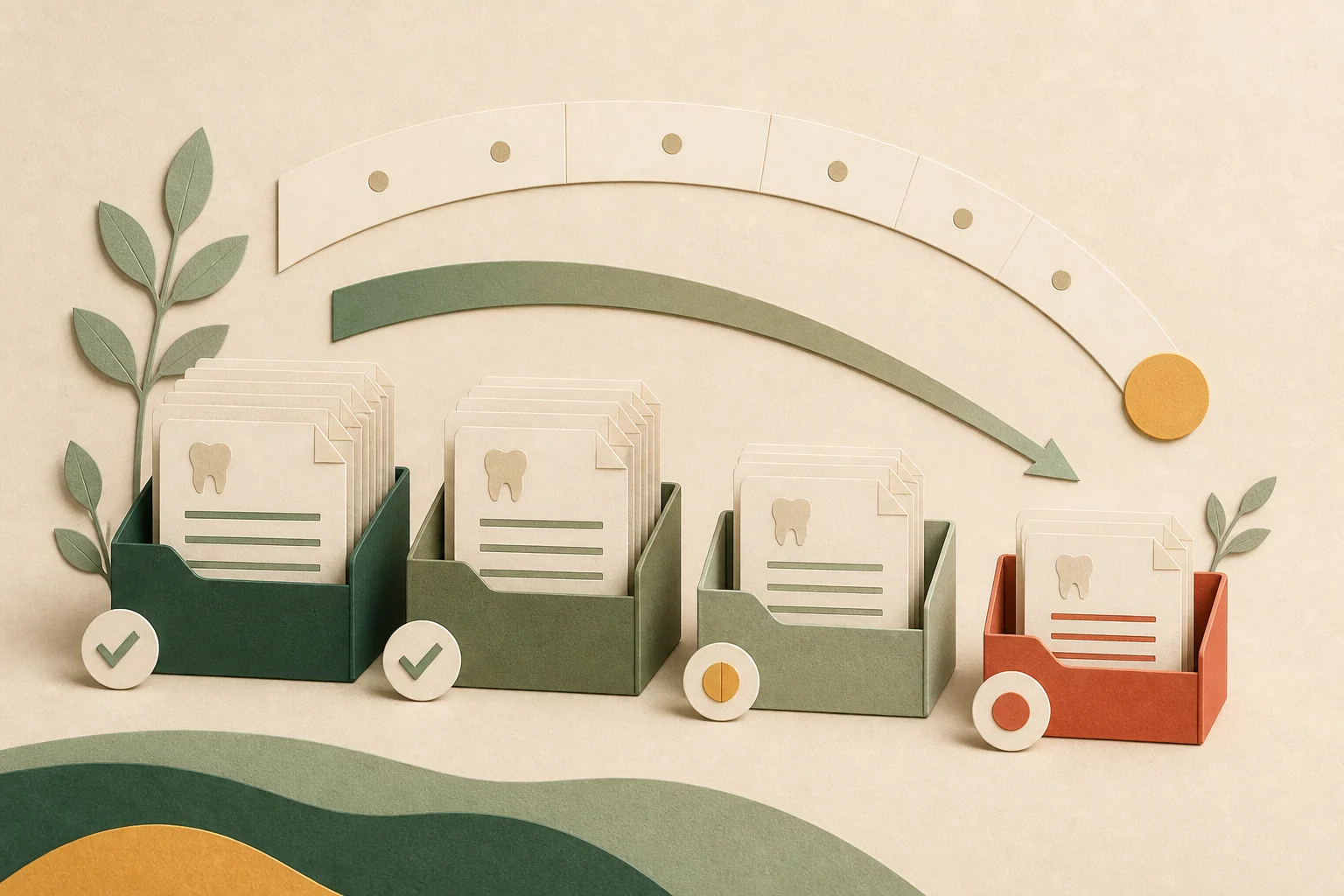
How should you test a dental clearinghouse before choosing one?
Use this dental clearinghouse comparison with a demo that follows one claim from submission to the ledger. Ask each vendor to show the same steps in a test account. A feature list doesn't tell your biller where to find a missing claim or which screen needs manual entry.
| Ask the vendor to show | Evidence to record |
|---|---|
| A submitted claim | Where your team sees the payer response and claim reference |
| An attachment | How the receipt stays linked to the correct claim |
| A rejected claim | Who fixes it and how the corrected submission is tracked |
| An ERA with an unmatched line | Where the exception appears and who resolves it |
| A payment posted to the PMS | The procedure amounts, adjustments, and remaining balance in the ledger |
Mark each result as demonstrated, manual step required, or not shown. Keep 'not shown' separate from 'not supported.' Ask for the supported route for your actual payer list and PMS version before treating a demo result as a fit for your office.
Open Dental's ERA workflow is one example of the matching and review steps worth checking. For an unmatched line, ask the vendor to show the recovery path as well as a payment that matches on the first attempt.
Take the completed checklist into a comparison of in-house and outsourced dental billing. It makes the work left with your team visible before you compare prices.
What is a dental clearinghouse?
If you're like most offices, you never really chose your clearinghouse. Your practice management software came with one, somebody clicked through setup years ago, and nobody has thought about it since.
That's not automatically wrong. But a few of the differences cost real hours every week, and most of them land on whoever posts your payments. Here's how the main ones compare.
A clearinghouse sits between your practice management software and the payers. You send it a claim, it translates that claim into the format each payer expects, routes it, and brings back the response. Three different vendors get called "the clearinghouse" in most offices, and they do different jobs:
- The clearinghouse routes claims and returns responses. DentalXChange, Vyne, EDS, Waystar, Optum.
- The payment vendor delivers the money and the remittance. Zelis and Echo are the common ones. Virtual credit card fees come from here, not from your clearinghouse.
- The billing service is people who work your claims for you, for a percentage of collections or a per-claim fee.
If you've ever spent twenty minutes on hold with the wrong vendor, you know why this matters. A claim that never reached the payer is a clearinghouse problem. A card payment with 3% taken out is not.
The main dental clearinghouses
| Clearinghouse | Known for |
|---|---|
| DentalXChange (ClaimConnect) | Dental-specific, two decades of payer connections, native in Open Dental |
| Vyne Dental (Trellis) | Full claims lifecycle platform, partnered with Patterson for Eaglesoft |
| EDS (Electronic Dental Services) | Dental-only, also native in Open Dental |
| Waystar | Large-scale RCM and analytics, common in DSOs and multi-specialty groups |
| Optum (formerly Change Healthcare) | Very large payer reach, and the sole dental option for some plans |
| Stedi | API-first, built for software vendors rather than front desks |
Stedi is the odd one out there. It's an API-first clearinghouse that practices reach through a software vendor rather than buying directly, which is worth knowing before you go looking for a login.
Your software already picked one for you
Open Dental publishes its native integrations, and for clearinghouses that list is short: DentalXChange and EDS. Dentrix has eClaims, which Henry Schein One calls the only claim service fully integrated into Dentrix. Patterson partnered with Vyne Dental for Eaglesoft.
Those defaults are business relationships between two software companies, not judgments about your payer mix. Sometimes the default is genuinely right. It's worth knowing it wasn't picked for you.
The practical version: is your clearinghouse inside your software, or a separate website your team logs into? A separate portal means claims live in one system and your ledger in another, and somebody reconciles the two by hand. Choosing the software itself is the bigger version of the same decision.
Why your ERAs don't auto-post
This is the difference most comparisons skip, and it's the expensive one. When a payment comes back as an ERA, your software has to match it to the right claim before it can post. Open Dental's ERA documentation notes that even a mismatched patient name can still process when other information lines up, such as the claim identifier.
That cuts both ways. Some clearinghouses assign their own claim IDs, and if those don't survive the round trip into your PMS, the match fails and somebody keys the payment in by hand. You've probably heard this from your front desk as "posting takes forever." Almost nobody traces it back to the clearinghouse.
You can check it in ten minutes. Take last week's ERAs and count how many posted without a human touching them. If most needed hands, payment posting is where your clearinghouse is costing you.
Most dentists remember February 2024
Change Healthcare went down in a cyberattack and stayed down for weeks. Practices that submitted through it lost their electronic path to the payers.
For some plans there was no second path to build. On March 8, 2024, Blue Cross NC told dental providers that for Dental Blue and Dental Blue Select, Change Healthcare was the only electronic clearinghouse option, and sent them to paper claims by mail or fax. The ADA tracked the fallout for months.
Henry Schein One rerouted Dentrix claims to another clearinghouse within 48 hours. Individual practices couldn't do that for themselves. Your software vendor may have a second route, and you probably don't. Claims that sat unsent for weeks are the same claims that age past appeal deadlines.
The questions nobody asks their clearinghouse rep
Every clearinghouse hands you a feature list. None of them raise these on their own.
- How many of my top ten payers do you reach directly? Not the total payer count. That number is always impressive and never means anything. The honest answer is a list.
- When a claim goes missing, whose hands go looking for it? Every vendor says they handle rejections and denials. Fewer will say who actually does the work. If it's your front desk in a portal, you know what you're paying for.
- What claim ID comes back on the ERA, and is it the one my software wrote? Most reps have never been asked this, and the reaction tells you as much as the answer.
- What happens to my claims the day you go down? They'll want to talk about uptime. What you're really asking is whether your payers take a claim any other way, and whether anyone in your office would know how.
- Who owns you, and what else do they own? Consolidation is why 2024 hit as wide as it did. A clearinghouse, a payment vendor and a payer's back end under one parent is three failures that look like one.
You don't need perfect answers to all five. A rep who can't answer any of them has told you something anyway.
Autumn connects to all of the clearinghouses above, so we see how each behaves on the way back into the ledger. If you want a read on what yours is doing to your posting, we do a free billing consultation. It doesn't take anything on your end.
What is the best dental clearinghouse?
There isn't one. Any list that ranks them is ignoring the variable that decides it, which is your payer mix. The best one for your practice reaches your top payers directly, connects into your PMS instead of a separate portal, and returns ERAs your software can match.
Is a clearinghouse the same as an EFT or payment vendor?
No. The clearinghouse routes claims to the payer. The payment vendor delivers the money and the remittance. Zelis and Echo are payment vendors, and the 2 to 3% virtual credit card fee comes from that side.
Can a dental practice use more than one clearinghouse?
Yes, and some do it for redundancy after 2024. The limit is that some payers accept claims through only one route, so a second connection doesn't always buy a second path.